|
||
Automatic Removal of the Influence of Buried Metallic Structures from Resistivity Measurements in SESResapAccurate determination of multilayer soil parameters is essential for reliable grounding system analysis, particularly in environments where nearby buried metallic infrastructure can distort resistivity measurements. To address this challenge, SES developed advanced methods to quantify and remove distortion effects by explicitly incorporating interfering conductors into SESResap-based inversion workflows. This approach enables improved consistency between measured apparent resistivity data and computed responses. At last year's Users' Group Conference (UGC 2025), SES introduced an automated distortion correction algorithm for the Driven-Rod resistivity method. This implementation requires detailed 3D modeling of adjacent metallic structures using SESCAD (e.g., MultiGround, MultiGroundZ, or MultiFields input data). By integrating these additional elements into the forward model, their influence can be numerically isolated and removed during inversion, ensuring that the resulting soil model is representative of the undisturbed subsurface. The robustness and accuracy of this methodology have been validated through field applications, demonstrating stable convergence and high-fidelity parameter recovery. Building on these results, SES has extended the automated correction framework to conventional surface resistivity techniques. We are pleased to announce at this UGC 2026 that this distortion removal capability is now implemented for the Wenner, Schlumberger, and generalized electrode configurations, preserving inversion accuracy across diverse measurement geometries. We show typical examples and provide the target input files for your reference. Additional enhancements include the introduction of spatial referencing for the driven rod through explicit X and Y coordinates of its origin, enabling precise geometric alignment with surrounding conductive structures. This enhancement improves forward-model accuracy in complex, infrastructure-dense sites. These developments are fully integrated within the SESResap environment, enhancing inversion robustness, reducing user intervention, and broadening applicability for both advanced and routine geoelectrical investigations. For example, a Wenner resistivity measurement 10 m away and parallel to the edge of a 50×100 m grounding grid buried in a two-layer soil (ρtop = 30 Ω·m, ρbottom = 170 Ω·m, h = 1 m). 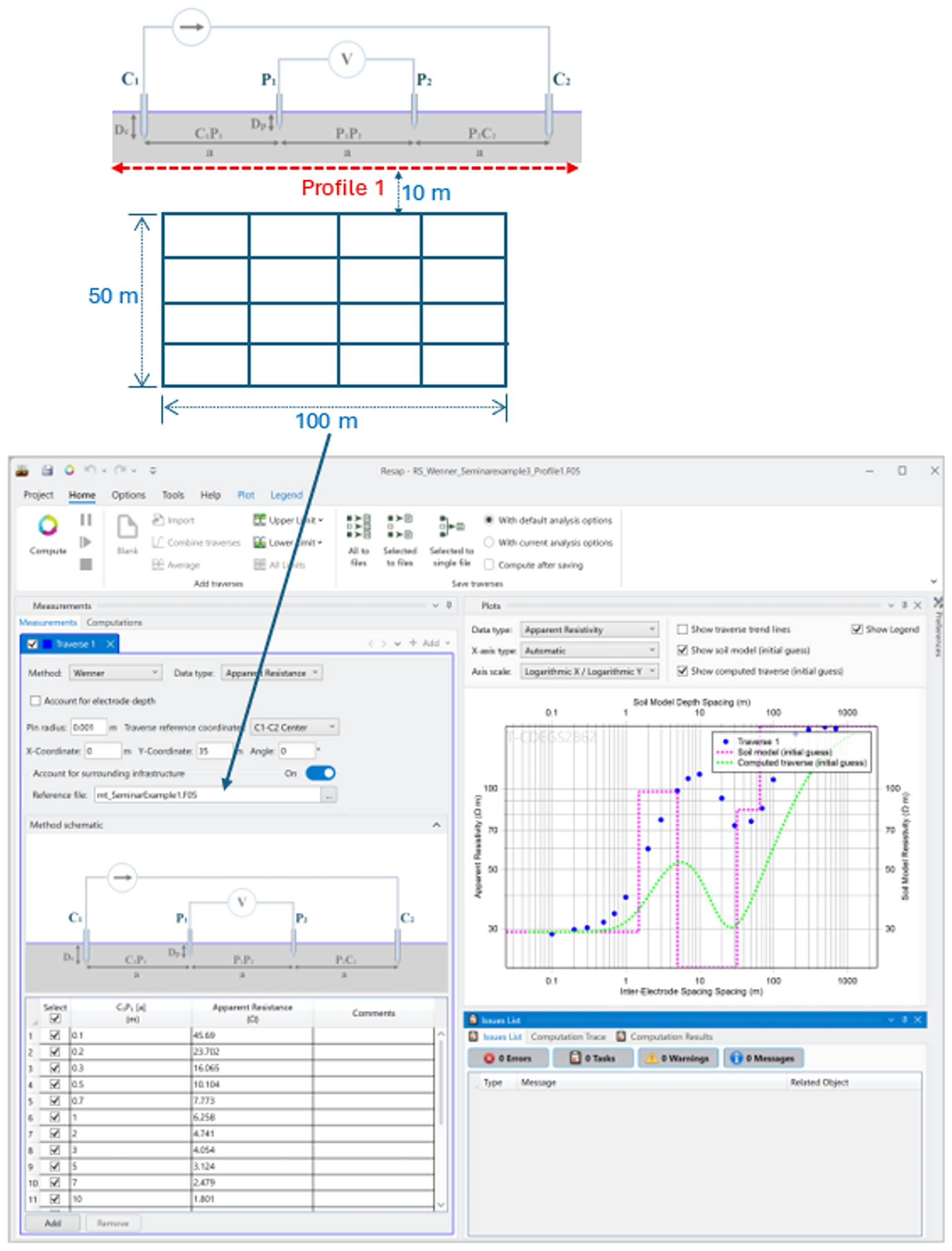
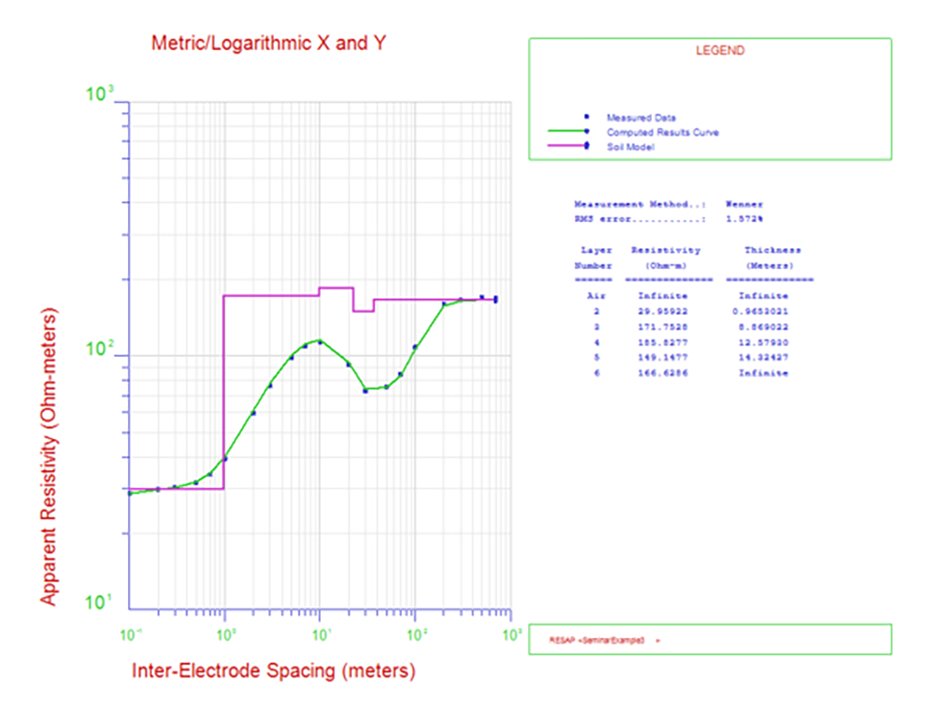
See the article entitled “Automatic Removal of the Influence of Buried Metallic Structures from Resistivity Measurements” in these Proceedings for further details. |
||
|
||
|
SES & technologies ltd. 3055 Blvd. des Oiseaux, Laval, Quebec, Canada, H7L 6E8 +1 (450) 622-5000 info@sestech.com ©2026 SafEngServices & technologies ltd. |